Article 499 of the Islamic Penal Code approved in 1392, the criminal legislator has removed the description of the loss of will contained in Article 326 of the Penal Code of 1370 regarding actions against oneself due to the intimidation of another, and has considered the only condition for the fall of the responsibility of the intimidated steward is his lack of discretion when committing the acts. In the meantime, the question can be asked whether the voluntary actions of the fearful officer in the situation of intimidation caused by another person can be considered as a justification for the legitimacy of the crimes against him in such a way that the results of the incident can be attributed to the responsible person. The result of the reflections is that at least three different approaches have been proposed regarding the detailed question, and it seems that the second theory is favored by the criminal legislator. The first approach tries to prove the absolute guarantee of terrible people by insisting on the "if it were not" criterion. The second approach, by focusing on the "voluntary involvement" of fearful people in entering the crime and insisting on "certain current indeterminacy" on the part of the fearful person, in contrast to the repulsive person in the state of reluctance, believes that there is no absolute guarantee of fearful people. The third approach, with the criterion of "predictability of danger" in addition to "conventional rational behavior towards creative panic".
Arabpour, Mehrab, the rule of dealing with damage, Tehran: Ganj Danesh Publications, 1377. )in Persian)
Allameh Hali, Hasan bin Yusuf Motahar Asadi, Qa'aab al-Ahkam fi Ma'rafa al-Halal wa Haram, Volume III, Qom: Islamic Publications Office affiliated with the Qom Theological Seminary Society, 1413 AH. (in Arabic(
Ameli, Javad bin Muhammad Hosseini, Miftah al-Karamah fi Sharh Qa'aa al-Allamah, Volume 10, Beirut: Dar Ihya al-Trath al-Arabi, 1413 AH. (in Arabic(
Alidoust, Abulqasem, "Jurisprudence and Custom", Qom: Research Institute of Islamic Thought and Thought, 2018. )in Persian)
Alidoost, Abulqasem, "Reference to custom in applying concepts to examples", Fiqh and Law Quarterly, 2 (1383), 11-32. )in Persian)
Clarkson, Christopher, Analytical Basics of Criminal Law, translated by Hossein Mir Mohammad Sadeghi, Tehran: Shahi Beheshti University Press, 1371. )in Persian)
Esfahani, Fazel Handi, Muhammad bin Hassan, Kashf al-Latham and Al-Abham on the Rules of Al-Ahkam, Volume 11, Qom: Islamic Publications Office affiliated with the Modaresin Society, 1416 AH. (in Arabic(
Ghamami, Majid, Eshraghi, Majid, "Separation of judicial matter from thematic matter in civil proceedings", Private Law Studies Quarterly 2 (2009) 275-294. )in Persian)
Gurji, Abolqasem, legal articles, first volume, Tehran: Ministry of Culture and Islamic Guidance, 1365. )in Persian)
Hosseini Maraghei, Sayyid Mir Abdul Fattah, Al-Anawin, Qom: Nashr al-Islami Institute, 1417 AH. (in Arabic(
Hosseini Shirazi, Seyyed Mohammad, Al-Qasas, Qom: Dar al-Qur'an al-Hakim, 1408 AH. (in Arabic(
Haji Dehabadi, Ahmed, "Reference of verification of the issue of law with an emphasis on participation in murder", Journal of Legal Studies, 1 (2014), 123-99.
Haji Nouri, Gholamreza, "Comparative study of causation approaches in civil liability", two quarterly journals of Islamic jurisprudence and law, 1 (2009): 61-89.)in Persian)
Hasanzadeh, Mahdi, an expert on evidence independent of the science of the judge, "Fiqh and Laws", 12 (186), 76-63.)in Persian)
Hikmatnia, Mahmoud, Civil Responsibility in Imami Jurisprudence, Qom: Research Institute of Human Sciences, 2016. )in Persian)
Hakim, Seyyed Mohammad Taqi, Al-Asul al-Umaa for Comparative Fiqh, Qom: Majma Al-Alami Lahl al-Bayt (AS), 1415 AH. (in Arabic(
Hali, Mohaghegh, Najm al-Din, Jafar bin Hasan, Shar'e al-Islam fi al-halal and haram issues, volume seven, Qom: Ismailian Institute, 1408 AH. (in Arabic(
Jourdan, Patrice, Principles of Civil Responsibility, translated by Majid Adib, Tehran: Mizan Publishing House, 2012. )in Persian)
Katouzian, Nasser, Introductory course of civil rights (legal events), Tehran: Sahami Atahi Co., 2015. )in Persian)
Khoi, Seyyed Abul-Qasim, Basics of Takmulah Al-Manhaj, Volume 42, Qom: Al-Imam Al-Khoi's Encyclopedia, 1418 AH. (in Arabic(
Mousavi Khomeini, Ruhollah, Tahrir al-Wasila, Qom: Ismailian Press Institute, 1409 AH. (in Arabic(
Murashi Najafi, Seyyed Shahabuddin, Al-Qassas Ali Light of the Qur'an, Qom: Library of Ayatollah Azami Murashi Najafi (RA), 1415 AH. (in Arabic(
Madani Kashani, Agha Reza, Kitab al-Diyat, Qom: Al-Nashar al-Islami Institute, 1408 AH. (in Arabic(
Mir Mohammad Sadeghi, Hossein, Crimes against individuals, Tehran: Mizan Publishing, 2016. )in Persian)
Mohseni, Farid, Malkouti, Nasir, "Causation Relationship in Islamic Penal Code", Judicial Law Journal, 79 (1391), 138-159. )in Persian)
Muqaddis Ardabili, Ahmed bin Muhammad, Majma al-Faidah wa Al-Barhan fi Sharh Irshad al-Azhan, Volume 14, Qom: Islamic Publications Office affiliated with the Qom Seminary Society of Teachers, 1403 AH. (in Arabic(
Najafi, Mohammad Hasan, Javaher al-Kalam fi Sharh Shar'e al-Islam, Volume 26, Tehran: Darul Kitab al-Islamiya, 1376. (in Arabic(
Najafi, Mohammad Hassan, Javaher al-Kalam fi Sharh Shar'e al-Islam, Volume 41, Tehran: Dar al-Kitab al-Islamiya, 1376. (in Arabic(
Sadeghi, Mohammad Hadi, Mirzaei, Mohammad, "The nature of the citation relationship and its verification criteria", Islamic Jurisprudence and Law Studies Quarterly, 21 (2018), 167-194. )in Persian)
Sadeghi, Mohammad Hadi, Taneh, Farzad, "The nature of authority and its place in criminal law", Criminal Law Research 21 (2012): 39-72.)in Persian(
Sabzevari, Seyyed Abdul Ali, Mahdez al-Ahkam, volume 28, Qom: Al-Manar Institute, 1413. (in Arabic(
Sadeghi, Mohammad Hadi, "Community of Sab and Mubasher in Islamic Penal Code 1392", Journal of Legal Studies 2 (1393): 97-123. )in Persian)
Sadeghi, Mohammad Hadi, Crimes against individuals, Tehran: Mezan Publishing, 2014. )in Persian)
Taheri Nasab, Seyyed Yazdullah, "The role of predictability of harm in the relationship of causation in the criminal law of Iran and England", Publication of legal research, 1 (2008): 187-230. )in Persian)
Taheri Nasab, Seyyed Yazdullah, Causation relationship in the criminal law of Iran and England, Tehran: Justice Publishing Institute, 2018. )in Persian)
Tusi, Muhammad Ibn Hasan, Al-Mabusut Fi Fiqh Al-Amamiyyah, Volume Seven, Tehran: Al-Maktabeh Al-Mortazawieh. 1378. (in Arabic(
Tripolisi, Ibn Baraj, Ghazi, Abdul Aziz, Al-Mahdez, second volume, Qom: Islamic Publications Office affiliated with the Madrasin Society, 1406. (in Arabic(
Wasali Naseh, Morteza, Parsapour, Mohammad Baqer, "Civil responsibility caused by fear of comparative study in Iranian Islamic jurisprudence and customary law", Comparative Law Researches, 2 (2015): 147-199. )in Persian)
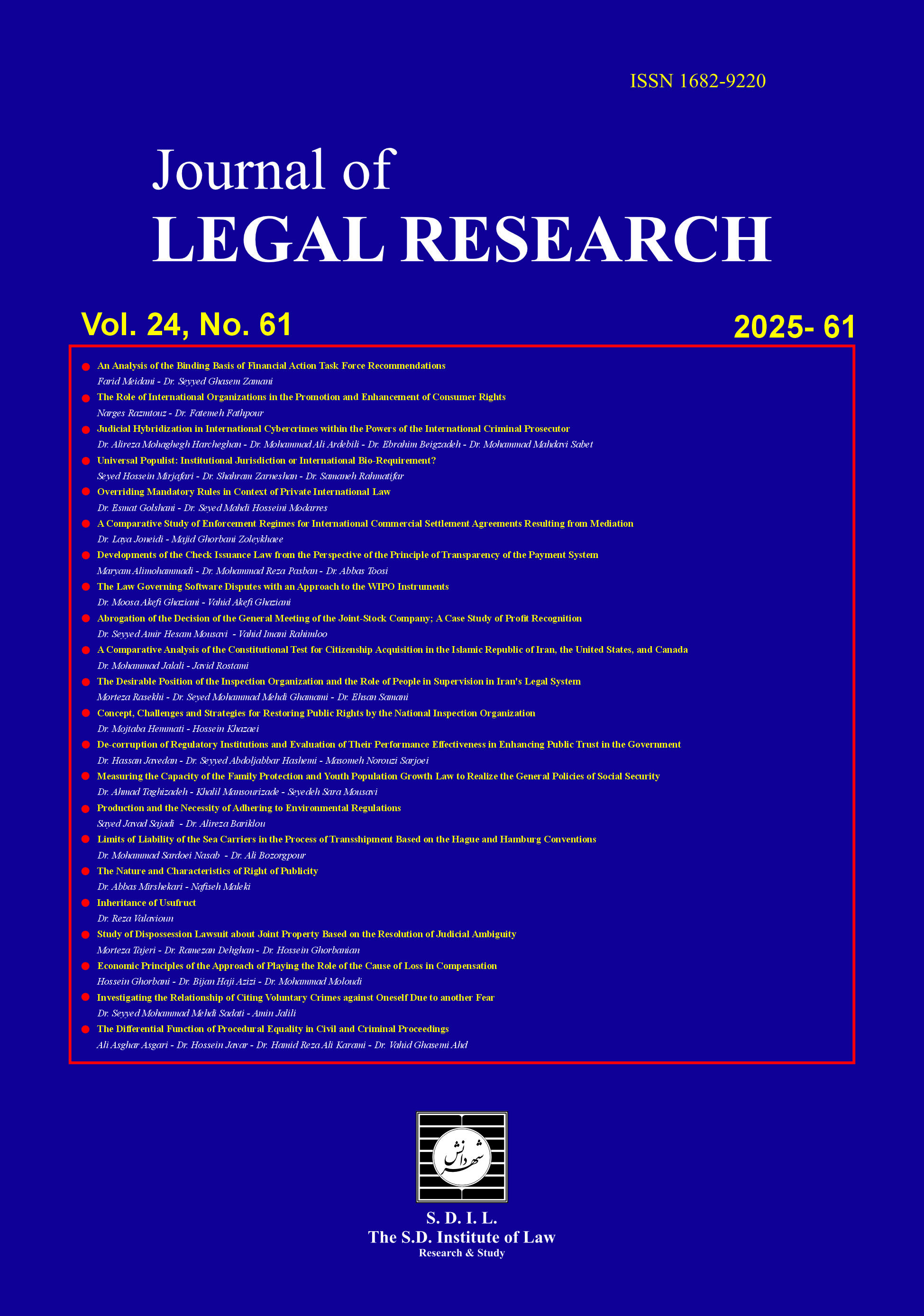
Sadati, S. M. M., & Jalili, A. (2025). Investigating the Relationship of Citing Voluntary Crimes against Oneself Due to another Fear. Journal of Legal Research, 24(61), 617-642. https://doi.org/10.48300/jlr.2023.405395.2384
MLA
Sadati, S. M. M., & Jalili, A. "Investigating the Relationship of Citing Voluntary Crimes against Oneself Due to another Fear", Journal of Legal Research, 24, 61, 2025, 617-642. doi: 10.48300/jlr.2023.405395.2384
HARVARD
Sadati S. M. M., Jalili A. (2025). 'Investigating the Relationship of Citing Voluntary Crimes against Oneself Due to another Fear', Journal of Legal Research, 24(61), pp. 617-642. doi: 10.48300/jlr.2023.405395.2384
CHICAGO
S. M. M. Sadati & A. Jalili, "Investigating the Relationship of Citing Voluntary Crimes against Oneself Due to another Fear," Journal of Legal Research, 24 61 (2025): 617-642, doi: 10.48300/jlr.2023.405395.2384
VANCOUVER
Sadati S. M. M., Jalili A. Investigating the Relationship of Citing Voluntary Crimes against Oneself Due to another Fear. Journal of Legal Research. 2025;24(61):617-642 (In Persian). doi: 10.48300/jlr.2023.405395.2384