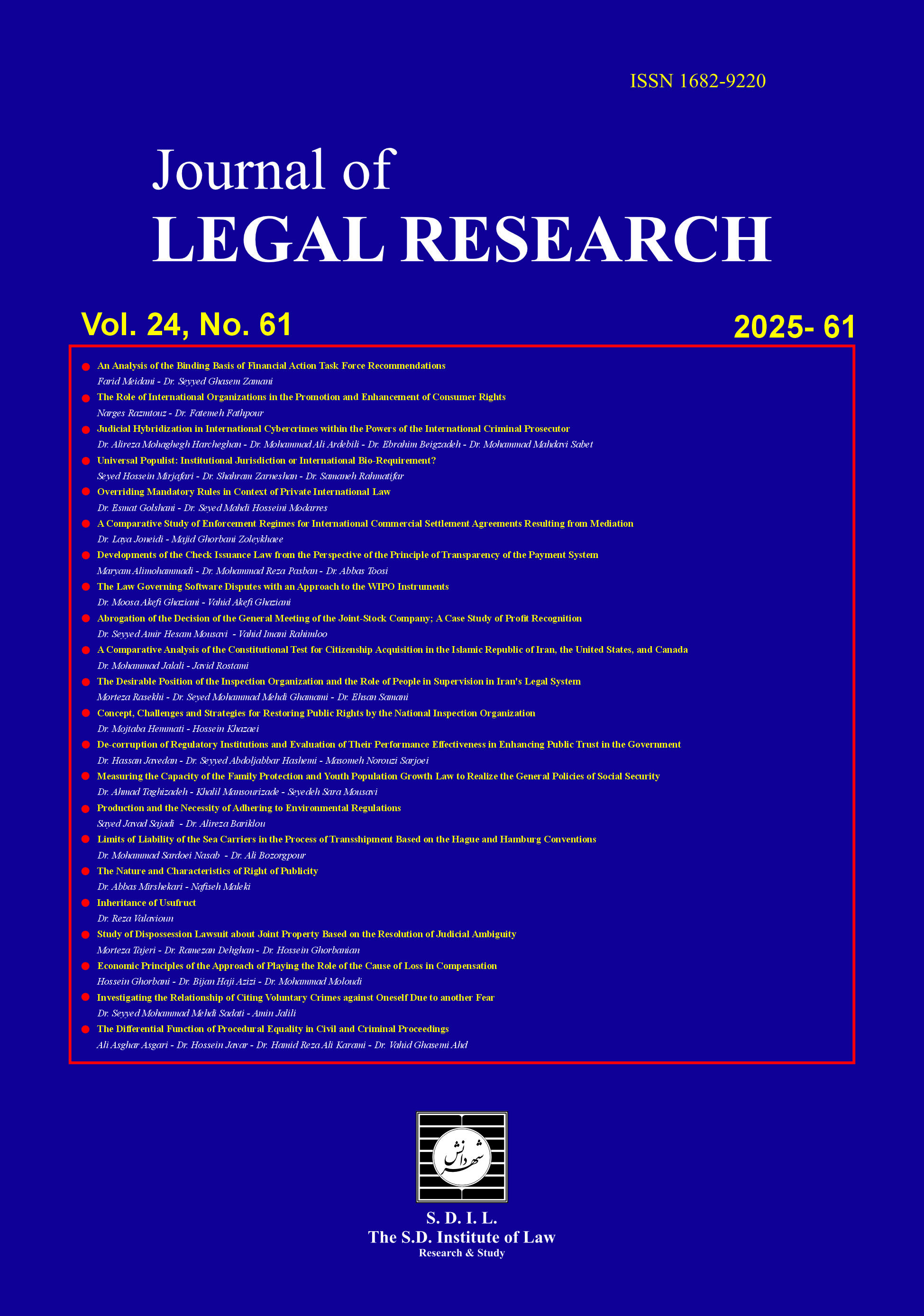
Document Type : Original Article
1.Ardabili, M. common Criminal Law. Vol II. 58th ed. Tehran: Mizan, 2022. (in Persian)
2.Abu Zari, M. Criminology of cybercrimes. 1st ed. Tehran: Mizan, 2015. (in Persian)
3.Javednia, J. Electronic Commerce Crimes. 2nd ed. Tehran: Khorsandi, 2018. (in Persian)
4.Ashuri, M. et al., "The International Criminal Court on the threshold of two decades of activity: challenges and achievements". Criminal Law Doctrines. 18(2018). (in Persian)
5.Brubacher, M.” Prosecutorial Discretion within the International Criminal Court”. 2 J.I. CJ (2004). (in English)
6.Bensouda, F. “Challenges Related to Investigation and Prosecution of the ICC”. Translated by Edith Roberto Bellelli. International Criminal Justice: Law and practice from the Rome Statute to its review. ASHGATE (2010). (in English)
9.Carsten, S. “Damned If You Do, Damned If You Don’t: Challenges and Critiques of Preliminary Examinations at the ICC”. International Criminal Justice 15 (2017). (in English)
10.Christensen, Robert. “Getting to Peace by Reconciling Notions of Justice: The Importance of Considering Discrepancies Between Civil and Common Legal Systems in The Formation of the International Criminal Court”. International Law and Foreign Affairs 6(2002). (in English)
11.Cherif Bassiouni, M., Hansen, Douglass. Contemporary Issues Facing the International Criminal Court. Brill: Nijhoff, 2020. (in English)
12.Cryer, R., Hakan, F., and Darryl, R. An Introduction to International Criminal Law and Procedure. Cambridge University Press, 2014. (in English)
13.Dashor, K. “Cyber Crime in the Society: Problems and Preventions”. Journal of Alternative Perspective in the Social Science 3(2011). (in English)
14.David,Bosco, Rough Justice: The International Criminal Court in a World of Power Politics, . Translated by Edith Aghai Jannat makan, Hossin, 1st ed. Tehran: Jaghal, 2020. (in Persian)
15.Debarati, Halder, and Jaishankar, K. Computer crime and victimization of women. Translated by Edith Raejean M., Koroeh Paz, H., and Salimi E. 1st ed. Tehran: Majd, 2013. (in Persian)
16.Danner, A. “Enhancing the legitimacy and accountability of Prosecutorial discretion at the ICC”. 97 A.J.I.L (2003). (in English)
18.Esmailzadeh, P. "Cyber-attack as a crime of aggression and examining the jurisdiction of the International Criminal Court in dealing with it". Criminal Law and Criminology Research 10 (2016). (in Persian)
19.Goldouzian, I., Pahlevaani fard, E., Asgarkhani, M., and Moradi, M. "Governing principles of criminal policy and legislation of cybercrimes". Iranian and International Comparative Legal Research 42 (2017). (in Persian)
20.Iftikhar, Jahormi, G., Eslami, E. "How to exercise the jurisdiction of the courts in dealing with crimes of cyber space". Law of Justice 88 (2013). (in Persian)
21.Kerstin, Bree Ca, Trying, H. ‘On Behalf of Africa’: Remaking Hybrid International Criminal Justice at the Chambers Africanis Extraordinaires, in: Strengthening the Validity of International Criminal Tribunals. Brill: Nijhoff, 2018. (in English)
23.Koskenniemi, M. Fragmentation of International Law: Difficulties Arising from the Diversification and Expansion of International Law. Report of the Study Group of the International Law Commission. UN Doc. A/CN.4/L.682, 13 April 2006. (in English)
24.Kulesza, Joanna. Protecting the Internet with international law. Computer Law & Security Review 40(2021). (in English)
26.Mumtaz, J., and Shaygan, F. International humanitarian law against the challenges of armed conflicts in the present era. 2nd ed. Shahr-E Danesh Legal Studies and Research Institute, 2017. (in Persian)
28.Michael, N Schmitt. Tallinn Manual on The International Law Applicable to Cyber Warfare2. Cambridge University Press, 2017. (in English)
29.Michael, N Schmitt. Tallinn Manual on The International Law Applicable to Cyber Warfare1. Cambridge University Press, 2013. (in English)
30.Misson, A. Cyberspace: The human dimension. New York: W.H. Freman and Company, 2008. (in English)
31.McEldowney, John. Hybridization: A Study in Comparative Constitutional Law. Penn State: International Law Review, 2010. (in English)
32.Moffett, Luke. “Meaningful or Effective? Considering Victims’ Interests Through Participation at the International Criminal Court”. Criminal Law Forum 26 (2015). (in English)
33.Ocampo, L.M. The International Criminal Court in motion. Translated by Edith Stahn C., and Sluiter G. The Emerging practice of the International Criminal Court. MartinusNijhoff: Leiden-Boston, 2009. (in English)
34.Ohlin, J. Peace, Security and Prosecutorial Discretion. Translated by Edith C. Stahn and G. Sluiter. The Emerging practice of the International Criminal Court. Martinus Nijhoff: Leiden-Boston, 2009. (in English)
36.Scafferling, C. International Criminal Procedure. Oxford, 2012. (in English)
37.Talita, De Souza Dias. “Interests of justice: Defining the scope of Prosecutorial discretion in Article 53(1)(c) and (2)(c) of the Rome Statute of the International Criminal Court”. Leiden Journal of International Law 30(2017). (in English)
38.Vagias, Michail. “Hybrid” Tribunals. International Conflict and Security Law, 2022. (in English)
39.Varaki, M. “Revisiting the ‘Interests of Justice’ Policy Paper”. International Criminal Justice 15(2017). (in English)
40.Wall, D. S. Cybercrime: The transformation of crime in the information age. Cambridge, UK: Polity, 2007. (in English)
41.Wisner, Sandra C. “Criminalizing Corporate Actors for Exploitation of Natural Resources in Armed Conflict: UN Natural Resources Sanctions Committees and the International Criminal Court”. International Criminal Justice 16(2018). (in English)
42.Zakavi, M., and Babaei, K. The Duties and powers of Prosecutor in the International Criminal Court. 1st ed. Tehran: Majd. (in Persian)
43.Zakir Hossein, M. "Powers of the Prosecutor of the International Criminal Court at the beginning of the preliminary evaluation process". Laws of Justice 117 (1401). (in Persian)
45.Zahar, A., and Sluiter, G. International Criminal Law. Oxford, (2008). (in English)